Robert Jordan and Anselmo’s comradeship
For Whom the Bell TollsRobert Jordan and Anselmo’s comradeship grows from a working alliance into a bond of mutual trust, joining military discipline to personal attachment. Its decisive test comes at the bridge: Robert Jordan depends on Anselmo’s observation and judgment, then entrusts him with a role in the demolition. When Anselmo is killed beside the bridge, their practical partnership is revealed as a source of belonging for both men and a profound loss for Robert Jordan.
Identity and Foundation
At the outset, Robert Jordan understands the dangers of operating behind enemy lines less as a question of personal fear than as a question of whom to trust. He believes that such work depends on trusting one’s companions completely or not at all. His growing reliance on Anselmo gives that principle a human form: their relationship is built through cooperation, but it reaches beyond the usefulness of an experienced guide or observer.
The alliance also carries a tension between command and respect. Robert Jordan is responsible for the bridge operation and gives Anselmo instructions, while Anselmo is experienced enough to propose alternatives and ask for clarification. Their comradeship does not erase their difference in role; it enables them to work within it without reducing Anselmo to a subordinate or Robert Jordan to a distant officer.
Trust, Discipline, and Companionship
A storm tests the men’s relationship through a small but telling act of obedience. Anselmo remains at his observation post as instructed rather than returning to camp, although Robert Jordan later recognizes that coming in would have been the intelligent and correct choice under the circumstances. He sees Anselmo’s decision to stay as exceptionally rare in Spain, where discipline and obedience to orders have often failed. For Robert Jordan, the episode demonstrates a quality he needs in a comrade: the willingness to remain at a difficult post because the mission requires it.
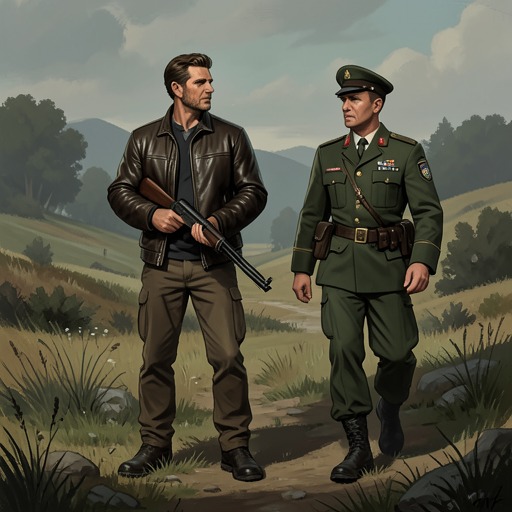
When Robert Jordan finds Anselmo again, his welcome is unmistakably personal. He puts an arm around the older man’s shoulder, holds him close as they walk, and tells him that it is good to see him and find someone in the same place where he was left. The gesture turns relief at recovering a reliable observer into an expression of affection. Anselmo, in turn, is happy that he stayed at his post; walking beside Robert Jordan in the storm, he no longer feels lonely. Their jokes and shared confidence coexist with the seriousness of the work, and companionship itself becomes a form of reassurance.
Shared Work and Mutual Instruction
Their cooperation continues through the reconnaissance and preparation for the bridge operation. Robert Jordan sends Anselmo to watch the road from his previous post or another suitable position, remain there until dark, and report on movement. Anselmo proposes instead to go into La Granja to learn what happened during the night and arrange for someone to observe during the day. Robert Jordan weighs that suggestion against the immediate needs of the operation and tells the others to let Anselmo go, noting that the day is not over and that the others understand the gun. The exchange shows Anselmo exercising initiative and Robert Jordan taking his contribution seriously, even as he retains responsibility for assigning the task.
At the bridge, trust becomes precise and practical. Anselmo asks Robert Jordan to make sure there is no mistake before crossing the gorge to take position at the other end. Robert Jordan explains what to do after the first shots, how Anselmo should help place the charges, and what to do if Robert Jordan is unable to continue. He also instructs him on aiming and waiting for the right moment. The detailed guidance is not merely technical: Robert Jordan entrusts Anselmo with a dangerous role while trying to make success depend on shared knowledge rather than guesswork.
Anselmo’s words and actions disclose the moral cost of that work. Before taking his position, he asks Robert Jordan’s pardon and leaves with a brief farewell. Later, as the operation unfolds, tears run down his cheeks. He acknowledges that they have to kill and that they do kill. The mission’s necessities do not dissolve his distress; the relationship gives him someone to address as he confronts it. Robert Jordan, meanwhile, is focused on placing the charges, passing packages, and securing them with wooden wedges between the bridge girders. Their comradeship operates in the midst of the task, through instruction, cooperation, and shared awareness of its human burden.
Death and Its Consequences
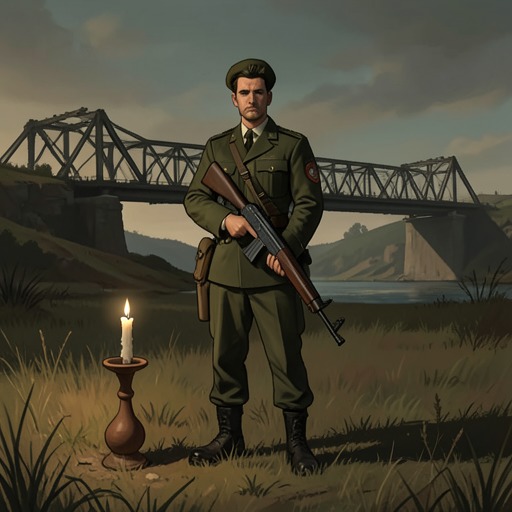
During the demolition, Anselmo fires from the far end of the bridge, and Robert Jordan hears the shot as he runs onto it. After the charges have been placed, Anselmo remains behind the white marker stone, holding the looped wire that will trigger the explosion. He feels calm and no longer lonely: his thoughts join him to the wire, the bridge, the charges Robert Jordan has placed, the man still working beneath the bridge, the battle, and the Republic. The moment gives their bond its fullest expression, not as a declaration but as Anselmo’s sense of belonging to a common undertaking and to the people carrying it out.
After the bridge operation, Robert Jordan finds Anselmo lying dead behind the marker stone, the wire still around his hand. He confirms that Anselmo is dead without turning him over to inspect what killed him. The narrative’s refusal to dwell on the physical details keeps attention on the fact that matters: the comrade entrusted with the final task will not return. Robert Jordan’s anger, emptiness, hatred, and despair follow the loss. He understands that soldiers turn sorrow into hatred in order to continue as soldiers, but that understanding does not blunt his grief.
Narrative Significance
The relationship links the bridge mission’s military discipline to the novel’s moral and emotional reckoning with violence. Anselmo’s obedience is neither mechanical nor uncomplicated: he stays at his post, questions how best to serve, asks for clarification, and experiences the act of killing as a source of distress. Robert Jordan’s trust in him likewise combines command with care, from the welcome after the storm to the careful instructions at the bridge. The two men’s work depends on precision, but their connection is measured in gestures and shared responsibility as much as in results.
Their ending also reverses the comfort that their companionship briefly provides. Anselmo had ceased to feel lonely beside Robert Jordan; after his death, Robert Jordan finds himself detached and alone with the emotional consequences of the operation. The wire and the bridge, once parts of a shared task, remain as the setting of that loss. Their comradeship therefore gives the demolition more than tactical stakes: it makes the cost of completing the mission personal, and leaves Robert Jordan to carry forward the bond as grief.